

Suspension trauma: Rescue plan needed
Suspension trauma is rare, but must be viewed as a serious possibility after a fall from height where the person is wearing fall protection equipment. Here, Alex Markham, height safety product & training manager at JSP, explains more about the dangers and about the importance of having a rescue plan in place before such an event occurs
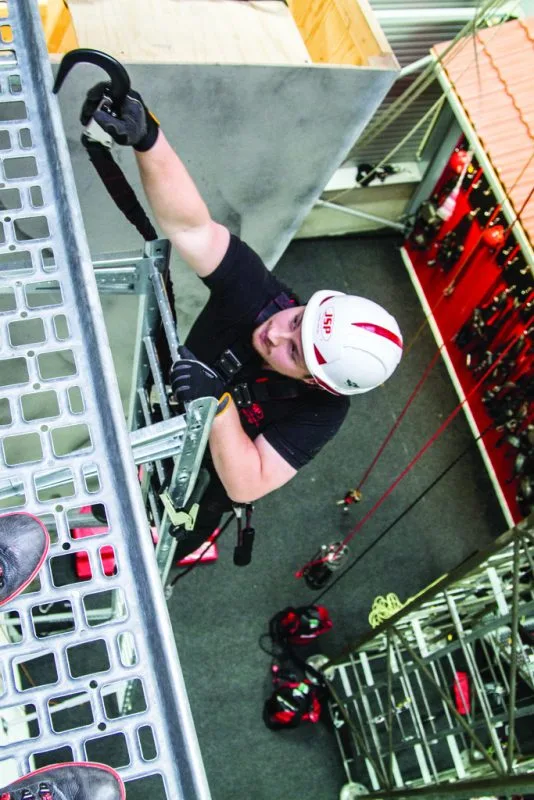
Suspension trauma, or orthostatic intolerance or suspension syncope as it is also known, can occur after any fall from height when a worker is suspended upright in their safety harness.
Owing to gravity, blood pools in the legs if they are not moved around, depriving the heart and lungs, and eventually the brain, of blood and oxygen. The worker can lose consciousness in minutes, and possibly die, if they are not rescued with the utmost urgency.
Good personal fall equipment design and health and safety practices have greatly reduced the risk of suspension trauma, but the risk remains and it is vital to get the person down as quickly as possible to avoid any possibility of harm.
Under Regulations 4(1) and 4(2) of the Work at Height Regulations 2005, employers must ensure all work at height is properly planned, including preparation for emergencies and rescue from height. Those carrying out rescue operations must be competent to do so.
Companies should be self-sufficient and not rely on the fire brigade in any suspension situation, although they can be called for support. Firefighters may not get there quickly enough, or have the specialist skills or equipment, to achieve a rescue from all scenarios, such as if the rescue were from a wind turbine, tower crane or other inaccessible location.
Rescue situations
The following are examples of situations in which a worker needs rapid rescue. It is easy to be injured during a fall, hitting the head, or suffering bleeding, broken limbs or even unconsciousness, rendering the casualty unable to rescue themselves.
• A maintenance operative wearing a safety harness working on a roof to service air conditioning units, clean guttering, or fix the roof can easily fall through a roof light or fall off the roof itself
• A construction worker by at an unprotected leading edge could fall over the edge and be left suspended in their harness
• A tower crane operator could suffer a heart attack or fall over and break a bone, so would be unable to climb down the ladder to safety.
There are many situations where someone could fall from height.
An organisation’s rescue plan needs to be tailored to each situation and should include rescue procedure, rescue kit, rescue team, means of communication, knowledge of equipment location, employee training and first aid procedures. It should be ingrained through training and practice.
Training
Trainees should already have basic work-at-height competence and skills in order to keep themselves safe before being put in a high-stress, high-risk situation. Potential rescuers must also be physically able and comfortable working at height.
Suitable rescue training courses will be mainly practical-based, with some additional classroom theory. The ultimate aim is for a rescuer to safely rescue a casualty while keeping all those involved safe. All potential fall risks should be covered.
Rescuers should be trained to use rescue equipment that may have many functions such as lifting and lowering capacity, auto-descent and lock functions.
Four steps must be achieved by rescuers:
• Keep themselves safe
• Find a suitable and sufficient anchor point to which to attach the rescue kit
• Make the correct attachment to the suspended casualty, who could be 2 to 3m below them, and may be unconscious.
• Remain in overall control – the operator of the rescue kit must have a hand on the rope with which they are controlling the rescue device, unless the device is locked.
The risk of suspension trauma features in the reasoning for having a rescue plan. Rescuers should be mindful of it, so that a rescue can be completed without delay. If the casualty is ignored, they will suffer from suspension trauma at some point and ultimately it might kill them.
Time is of the essence when someone falls in a harness. Having an adequately resourced, suitable and effectively-organised rescue plan is key.
IPE Newsletter
IPE publishes a weekly eNewsletter, delivering a carefully chosen selection of the latest stories straight to your inbox.
Subscribe here