

Thinking big
Moving fully fitted out modular data centres that weigh 18t
is not a job for a lightweight machine, which is why
BladeRoom is taking delivery of the largest 4-way Combilift
forklift to be built so far
The shareholders
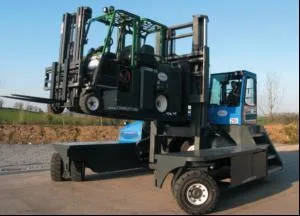
Moving fully fitted out modular data centres that weigh 18t
is not a job for a lightweight machine, which is why
BladeRoom is taking delivery of the largest 4-way Combilift
forklift to be built so far
The shareholders of the BladeRoom
Group previously ran the PKL Group,
a global supplier of portable kitchens
used for large scale events such as the Beijing
Olympics. The company also has a division
named ModuleCo which designs and builds
modular hospitals including operating
theatres. By pooling the key expertise of
these operations – heat extraction and air
management, BladeRoom has devised a
solution to reduce the vast amounts of
energy needed to cool banks of servers. This
will not only enable companies in the IT
sector to save millions of pounds on
electricity bills but is also hugely beneficial to
the environment.
“Servers generate exceptionally large
amounts of heat – this sector is second only
to the aviation industry when it comes to
energy consumption,” says BladeRoom CEO
Paul Rogers. “Our pre-engineered factorybuilt
data centres incorporate computer fluid
dynamics to extract the maximum amount
of heat with the minimum use of mechanical
cooling. This has enabled us to achieve a
world beating PUE of 1.1.”
A key part of the streamlined and efficient
manufacturing process was a watertight
handling system at BladeRoom’s new
production facility in Cinderford,
Gloucestershire. Having looked at a number
of conventional handling vehicles on the
market, the company decided that they were
not going to be up to the challenge of easily
and quickly manouevering the 14 x 4.2m
finished modules in and around the site.
BladeRoom’s materials handling
consultant HFT Forklifts (Hereford)
investigated various possibilities including
overhead gantry cranes and very large
counterbalance trucks. The cranes were
considered expensive and not practical to
install in an L shaped building. The sheer
physical size of a counterbalance forklift
capable of moving loads of 18t at extended
load centres would have taken up too much
space in the manufacturing area.
Paul Rogers continues:”Materials handling
is a crucial part of the build process and with
the help of Kevin Heath at HFT we realised
that one possibility was a much larger version
of the 12 and 14t capacity Combilifts that we
were already using. These have been
invaluable for moving raw materials such as
14m long RSJ’s and for lifting assembled roof
units onto base units, so it seemed sensible to
also look at a 4-way customised approach to
handle the finished modules. ”
Together with Combilift’s official
distributor in the West Midlands Abex, and
Combilift design engineers at the factory in
Monaghan, specifications were drawn up for
the super sized C25,000 model that will be
shipped to Cinderford. Its capacity will allow
BladeRoom to easily lift the fully fitted
modules into place for pre delivery testing.
“The ideal solution from our point of view
was a machine that could move modules in
the same way as other operations move
pallets – just on a much larger scale of
course,” says Rogers. “Thanks to the excellent
customer service from all involved – HFT,
Paul Raymond of Abex and Combilift direct
– this is exactly what we will have in place.”
In spite of the truck’s size – it measures
5m by 5m, with a 3.2m high cab, its
exceptionally manoeuvrability will enable
BladeRoom to lay out the manufacturing
area more efficiently.Modules will be placed
in rows to allow the Combilift to travel
sideways along gangways between them, and
the 4m lift height will enable modules to be
doubled stacked.
BladeRoom’s quality ‘plug and play’
modular data centres can be supplied in 18
or 20 weeks. The Combilift’s flexibility to ‘go
anywhere and do anything’ as Rogers puts it,
will enable the company to proceed at the
required pace to fulfil orders on the books as
well as to cope with the growth it expects
due to more and more interest from major
plcs around the world.
A critical issue in the design of the
recently-launched Combilift C25,000 was its
platform height. The size of three single
wheels required for a machine of this weight
would have resulted in an unworkable
platform height, but by using double wheels
the platform has been kept to 1150mm.
Hydraulic fork positioners have also been
incorporated as a standard feature, making
life easier for the driver for whom it would
be almost impossible to shift the extremely
heavy forks manually. The shotblasting
facility at the company’s Monaghan assembly
plant factory was not large enough to cope
with assembled parts so steel elements were
treated in sections before
being assembled.
Martin McVicar,
managing director,
comments: “We were
definitely faced with some
issues when we embarked
on this project, but our
engineers once again rose
to the challenge to create a
Combilift which will do
the job perfectly for the
customer and which is
remarkably manoeuvrable
considering its size.”
Related posts
IPE Newsletter
IPE publishes a weekly eNewsletter, delivering a carefully chosen selection of the latest stories straight to your inbox.
Subscribe here