

Unloading the risk of work at height
Loading, checking and unloading vehicles in an industrial or
construction environment is often underestimated as a
serious health and safety risk. Here Kevin Wilkinson,
business manager at LoadSafe Platforms, discusses the
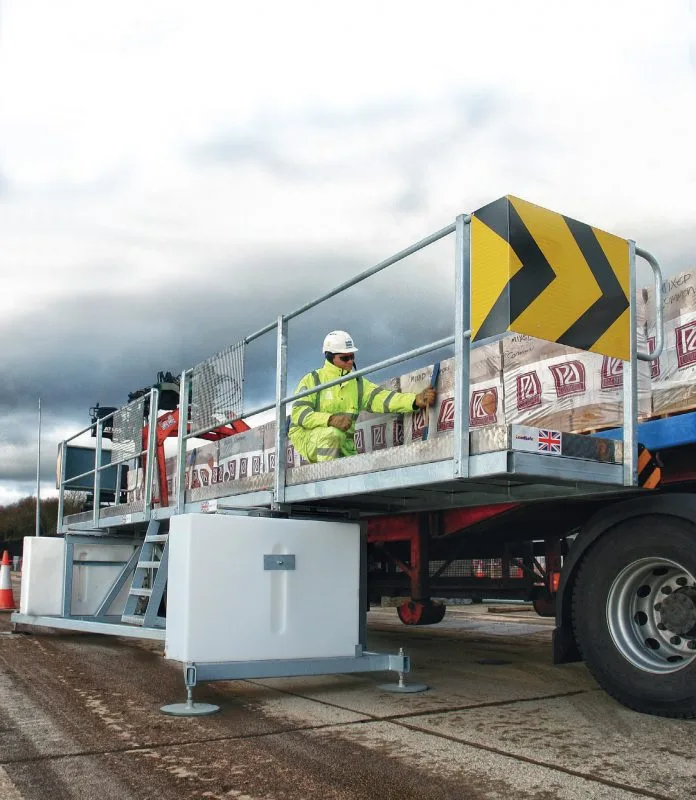
Loading, checking and unloading vehicles in an industrial or
construction environment is often underestimated as a
serious health and safety risk. Here Kevin Wilkinson,
business manager at LoadSafe Platforms, discusses the
options for a safe, secure and speedy way to check lorry
loads on busy sites
Over 75% of major falls from vehicles
happen during the loading or
unloading process. That equates to
around 2000 workers a year who suffer
serious injuries involving vehicles. Accidents
and injuries on site come at a great cost, both
financial and otherwise, for all involved. By
reducing the risks both employees and
employers opt for a significantly improved
working environment.
Even though the 2005 Working at Height
Regulations apply to the checking, loading and
unloading of vehicles and the fact that
employers have a duty of care to assess the
risks of working at height, many workers still
fail to follow correct procedures. This could be
down to several reasons; lack of time, lack of
equipment or equipment that is time
consuming to put in place. It is often easier to
simply climb up the back or side of the lorry to
check the load but this is a dangerous habit
that can have drastic consequences if the worst
should happen. In the construction industry
alone 70% of falls from vehicles happen to
non-drivers, and most of these occur during
the loading and unloading stages.
Fall arrest systems are now a legal
requirement in the construction industry
and there are several systems available.
Perhaps the most recognised is the safety air
cushion or airbag protection system. This
method does not prevent falls but aims to
reduce the risk of injury in the event a
worker does fall. Although effective it can be
cumbersome and time consuming to set up,
plus there is little flexibility with regards
moving the system around to accommodate
workers due to the large footprint required.
They also rely on air pressure fed from a
compressor to fill and maintain the air
supply, which is time consuming and
requires fuel to operate.
Safety nets are another potential solution,
however these are often used for working at
greater heights. Considering most accidents
involving vehicles in the workplace occur at
lower than head height, a safety net is not
always the best solution in this instance.
Another fall arrest method is similar to
the airbag, but uses soft bean bags instead of
air bags. Usually these bags can be used on
heights of up to 2m and work in the same
way as the airbags to reduce injury from falls
rather than prevent falls. Although, these
bags are generally easier to manoeuvre on
site there are still the issues of transportation
and storage while on site.
A fall arrest system has to be flexible
enough to cater for the demands of a
continually changing environment while still
providing the highest level of safety and
security. Specifically where the loading,
checking and unloading of vehicles is
concerned one of the key qualities for any
safety system is quick and easy set-up. A
loading platform is suitable for any site that
has a continuing turnover of vehicles coming
and going.
Loading platforms vary greatly in both
size and siting flexibility. An efficient
platform is one that can be easily positioned
on site to allow the stream of vehicles to flow
smoothly. Platforms, such as those from
LoadSafe, provide this flexibility by
lightweight design and are easily positioned
on site using available plant vehicles such as
forklifts. Stability is maintained by using
water filled Intermediate Bulk Containers
(IBCs) while robust linear bearings slide the
platform into the required position easily.
Just one person is needed to operate it. The
whole platform is then secured using a
spring-loaded bolt.
In addition to the above, a key element of
an effective platform is a safety rail that
travels the entire length of the platform with
an access point for users. Here again,
LoadSafe Platforms meet the needs of site
workers, providing a full length rail with
optional safety harness and a central staircase
for easy access. This type of platform goes a
step further than some alternative safety
methods by significantly reducing the risk of
a fall, rather than the risk of injury from a
fall. It is simple and quick for drivers and
operators to use, therefore dissuading them
from continuing to use unsafe practices
during the loading, unloading and checking
of loads.
IPE Newsletter
IPE publishes a weekly eNewsletter, delivering a carefully chosen selection of the latest stories straight to your inbox.
Subscribe here