


Valve choice key to efficiency
The importance of correct valve selection for pharmaceutical
production processes is evidenced by the benefits it
provides, as Ian Webster,hygienic processing field segment
manager at Burkert Fluid Control Systems, explain
The importance of correct valve selection for pharmaceutical
production processes is evidenced by the benefits it
provides, as Ian Webster,hygienic processing field segment
manager at Burkert Fluid Control Systems, explains
As well as delivering equipment and
installation savings, optimised valve
selection can eliminate all dead legs,
meaning that sterility is easier to ensure and
maintain. It can also mean faster flow shifts
and reduced risk of cross-contamination.
The compact design of the latest single
diaphragm valves, combined with manifold
blocks, ensures minimal hold-up volumes,
increased product yields and less media waste.
Traditional solutions are generally based
around diaphragm valve technologies. These
make use of closely welded cluster
arrangements, with the shortest possible
tangents and optimised positioning according
to draining/cleaning requirements. However,
even with optimised design, the requirement
for minimised hold-up volumes can often be
compromised by complex valve clusters – the
more valves needed, the more welds, pipe
lengths, T-pieces that are required, and the
more hold-up volume generated.
In addition, valve clusters can militate
against fast and accurate flow shift. If the
accuracy of the flow shift is higher and more
reliable, then the relationship between
concentrated product and the separation
step can be controlled more closely. This will
reduce product loss and have a positive
impact on the ROI of the installation.
Another challenge with the clustering
approach is that in larger systems the complex
arrangement of valves, and their individual
size, can result in large and heavy clusters
that have to be supported, and be easily
accessible for maintenance. The larger the
valves needed, the more space is required,
and when considering the need for fully
drainable, cleanable systems, this is not ideal.
New technology and manufacturing
advances have resulted in new designs based,
for example upon Robolux valves and
custom-manufactured stainless steel valve
blocks.With this design, hold-up volume is
eliminated by reducing – by half or more –
the number of valves, diaphragms, pipe
fittings and welds required in a system.
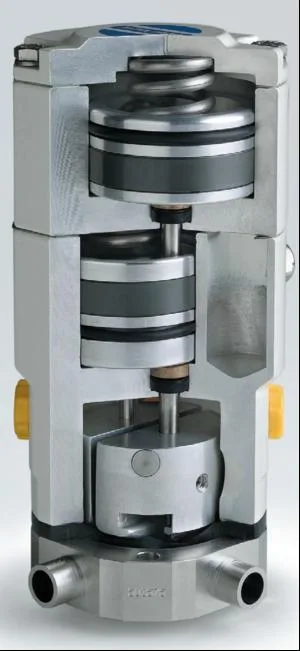
Based on diaphragm valve technology, the
new generation of valves combines
independent dual process switching
functions or ‘2 seats’ in a single body with a
single diaphragm and single actuator. The
actuator has independent pistons – one for
each seat, offering a compactly-designed
multi-port valve requiring about 40% less
space than traditional valve manifolds using
conventional diaphragm valves. Since less
material is used in the valve bodies, they can
be heated more quickly to sterilisation
temperature. A low internal volume, and
elimination of dead space supports faster
cleaning and boosts process efficiency and
higher product yield from the process.
Continuing the benefit of minimum space
requirement, the overall number of valves, Tpiece,
weld joints and pipe runs are greatly
reduced. The result is an optimised footprint
that reduces installation and maintenance
costs and minimises downtime.
The cleanability of a pipe system is
influenced by dead space volumes and the
application of the 3D rule. Currently, the
industry is satisfied with the 3D rule. Its
consistent application ensures sufficient
flushing for many processes. Dead legs will
be completely flushed and cleaned only if the
length of the dead legs is less than three
times the diameter of the main pipe.
It is usually not possible to consistently
implement the 3D rule when arranging
complex configurations with conventional
valves; the goal of any plant operator and
planning engineer is to remain well below
the requirements of this rule. One solution is
to achieve the 1D rule now, and the Robolux
valve solutions are capable of this. The
internal volume of the valves and/or valve
manifolds is smaller than with conventional
valve solutions and there is no dead volume
inside them.
If four conventional DN25 diaphragm
valves are welded in a typical steam cross
configuration, this results in an internal
volume of 90ml held in the pipe section
between the 4 valve seats. If this solution is
enhanced by using a standard valve block,
the internal volume can be reduced to 50ml.
Finally, if the standard valve block is replaced
with a Robolux valve, the total inner space
volume is only 22ml. These valves minimise
installation space, the amount of flushing
agent needed, and time. The cleanability of
the pipes and valve manifolds is important
for another reason: Improper flow through
the body may result in corrosion. Robolux
valve interfaces can help prevent corrosion.
Valve interfaces must meet high standards
to guarantee reliable processes and yet
remain flexible for different applications.
Robolux valves can provide a ‘double block
and bleed function’ to prevent steam used for
sterilisation of the parallel line from
contaminating the product and vice versa; it
is achieved by using a relief valve in between
the two seats.Multi-port valve bodies enable
the effective implementation of many
complex applications. For example, parallel
operation is possible with the use of a
Robolux DFP (Double Flow Path) interface
which increases
overall availability of
the plant and saves
production time.
Multi-port valves
can act as a sterile
barrier; a solution
using two actuators
and 2 diaphragms
provides the function
of a steam barrier
with 4 connections
and 4 seats that
replaces four
conventional valves
with their single
actuators, and the
corresponding piping
and connecting
elements.
Robolux valves
come with either
manual or pneumatic
actuators in sizes
from 1/4 to 2in (DN4 –
50). They are made
with a choice of body types: 316-L stainless
steel, ultra-pure polypropylene,
polypropylene USP V1 and PVDF. The valves
also offer a range of diaphragm materials to
suit all types of media, including EPDM,
FKM, PFA/ EPDM, PTFE, Silicone and
PFR91. Robolux valves hold all major
certifications.
Related posts

IPE Newsletter
IPE publishes a weekly eNewsletter, delivering a carefully chosen selection of the latest stories straight to your inbox.
Subscribe here