

Ways of lifting process efficiency
Andrew Pimblett, managing director of Street Crane
Company outlines some of the options available at the
lighter end of the lifting range and how these contribute to
improved process efficiency and productivity
Overhe
Andrew Pimblett, managing director of Street Crane
Company outlines some of the options available at the
lighter end of the lifting range and how these contribute to
improved process efficiency and productivity
Overhead travelling cranes, providing
full hook coverage of the entire
manufacturing area, will always be
the backbone for lifting and transportation
in manufacturing and stockholding and
remain an effective means of servicing an
entire factory bay.
However, there are many situations where
reliance on overhead cranes as the sole means
of moving or manufacturing product can
cause process inefficiencies. This may arise
where there are localised workstations
operating a high frequency of lifts appreciably
below the main crane capacity. Also, it may
arise in moving product through the bay where
the operator has to wait for the main crane or
leave the workstation to bring in the crane.
The lack of localised handling for loading and
unloading capital intensive plant – such as
machining centres – can also lead to extended
cycle times and under utilisation of these assets.
In all these cases supplementary, localised
handling, will improve productivity, cycle
times and the return on investment. There are
a number of options available. Fixed chain
hoists will meet the need for fixed position
lift and drop. Chain hoists on track beams or
monorail add lateral movement to this
function and light cranes extend this capability
to give double axis movement. For heavier
lifting slewing jib cranes can be specified.
Chain hoists and light mono rails
Auto/marine workshops, loading bays and
lifts between floors are typical situations
where a fixed position eye suspension chain
hoist provides useful vertical axis movement.
Street Crane Company’s chain hoists are
available in capacities up to 5t, but entry
level models rated to 0.125t meet lower
capacity handling needs.
For lateral movement the chain hoist can
be supplied with a trolley on a light beam or
mono-rail. The rolling resistance of a chain
hoist in this set up is typically 1% of the load
and so manual rather than motorised trolley
movement is often sufficient.
Light crane systems
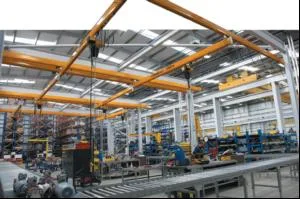
Light crane systems provide complete access
to the work area with full vertical movement
with x and y movement in the horizontal
plane. The work area may be a production cell
or workstation or, indeed, a single light crane
system may service a series of workstations
allowing product to be transferred easily
down the line. Light cranes will be used for
lighter movement and assembly operations,
maximum loads are typically to 2t.
The beams used in light crane systems are
roll formed light steel sections that have
good rigidity and an exceptional strength to
weight ratio. This means they impose
minimal load on the building frame. Light
weight floor standing gantries can be
provided where attachment to the existing
structure is not possible.
Various beam and trolley configurations
are available depending on operational or
site requirements. Underslung hoists on
single beams will often suffice for light
assembly operations. For heavier lifts, or
situations where height restrictions require
the hoist to be raised above the beam height
then double beam configurations are more
usual.
Slewing jib cranes
Jib cranes are typically used for localised lift
and travel in loading machines, servicing
welding bays or loading conveyors and floor
travelling trolleys. They fit into the handling
picture somewhere between light cranes and
workshop cranes, handing loads in the 125kg
to 5t range. There are two main jib crane
configurations, pillar/post mounted or wallmounted.
Depending on where it is located
in the workshop, the boom of a postmounted
jib crane may rotate up to 360°.
Static wall mounted jib cranes can sweep
almost 180°. A variation on the wallmounted
jib crane is the travelling wallmounted
jib crane. This can service a far
greater workshop area giving far greater
flexibility.
Jib cranes can be fitted with chain hoists
for lighter handling or wire rope hoists for
loads at the heavier end of lifting. Floor
structures need to be sound or, if necessary,
reinforced for post mounted jibs. Structural
frames or custom made steelwork must be
sufficiently robust to accommodate the loads
imposed by wall mounted jib cranes.
Design for purpose
Whatever the handling need, it is important
to select the right crane for the purpose.
Crane systems need to be carefully specified
to meet both current and future production
demands. Often a combination of traditional
overhead cranes and lighter localised crane
systems will provide the ideal flexible
solution, permitting efficient use of capital
and manpower resources.
IPE Newsletter
IPE publishes a weekly eNewsletter, delivering a carefully chosen selection of the latest stories straight to your inbox.
Subscribe here