

Wipers:What to use where
What type of wiper should you choose for general cleaning,
polishing, mopping up spills and for hygiene-critical wiping?
Where should you position your wipers for maximum
productivity? Tork manufacturer SCA advises on pick
What type of wiper should you choose for general cleaning,
polishing, mopping up spills and for hygiene-critical wiping?
Where should you position your wipers for maximum
productivity? Tork manufacturer SCA advises on picking the
correct wipers – and suggests where they should be located
Any wiping task in an industrial facility
usually requires immediate attention.
For example an operative with greasy
hands will want to wipe them clean before
starting on the next task. Similarly, an
operative who has spilled a quantity of oil on
to the floor will want to rectify this without
delay to prevent slips and falls. So it makes
sense for the right wiper to be always close at
hand.
But wipers come in all shapes and sizes
and each product is geared towards a specific
task. And if the wrong wiper is used, it could
prove ineffective – or even damage the
wiping surface.
Rags are commonly used for general
wiping purposes in industry and a bag of
mixed rags is often provided for cleaning
soiled hands, surfaces and components. But
unless the rags have been sorted and graded
before use, an operative cleaning a delicate
metal component might pull out an old pair
of jeans from the ragbag – complete with zip
– and scratch the component beyond repair.
Similarly a member of staff who spilled a
quantity of oil on the floor
would have little success in
trying to mop it up with a
synthetic rag. Items of
clothing made from synthetic
materials often have a ‘dry
clean finish’ that can repel
water and offer very little
absorbency.
Accommodating a supply
of rags in a typical
workshop can be an issue.
A typical ragbag can weigh
about 10kg which means
that it will probably need to
stay in one fixed position on
the floor. This means that any
employee seeking to mop up an oil spill
would have to leave their work bay or cubicle
to access a rag.
In larger factories the walk to and from
the ragbag could take several minutes – and
productivity would suffer in a facility where
operatives are taking regular trips to the
ragbag.Meanwhile, the spill on the floor
represents a slipping hazard for other staff.
So, not only should the right wiper be
supplied, it should be situated so that it is in
the right place when the operative needs it.
Tork wipers and cloths are designed to
offer characteristics such as strength,
softness or absorbency – or all three. In
manufacturing environments there are
multiple applications for wipers from
wiping oil and grease to polishing delicate
printing equipment, and each task requires a
wiper with different attributes. The wiper
should be specified for the task.
For example, industrial manufacturers can
choose between tissue products and nonwoven
wipers. Tissue products are made
from cellulose fibres while non-wovens use
different types of fibres – some man-made –
to create stronger products.
The longer the fibres, the stronger the
product because their length enables them to
be bonded together more effectively. Tightlybonded
wipers are more absorbent, longer
lasting and lower-linting because fewer fibres
are likely to break away from the product.
An example of a strong wiper made from
tightly-bonded fibres is Tork Premium 530.
This is made from a mix of cellulose and
long, strong, high quality man-made fibres
which are entangled firmly together to
produce a wiper that can absorb a variety of
liquids without breaking up.
Tork Premium 530 is suitable for use
when carrying out tough wiping tasks,
particularly where solvents are required since
the wiper will not break up in solvents.
Tork Premium 510 is recommended for
carrying out more delicate tasks – such as
wiping fingermarks from a screen or another
easily-damaged surface. The product is
strong and absorbent with soft fibres.
It is important that the factory manager
identifies which wiping tasks need to be
carried out in each work bay and supplies
the right wipers for each. This is where
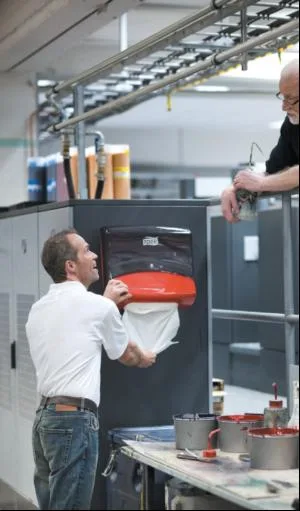
compact systems such as the Tork
Performance W4 wiping system offer a
solution. The system consists of a dispenser
containing 100 to 150 wipers that can be
wall-mounted in any workstation or
production area. The lockable, sealed
dispenser protects the wipers before use.
Most Tork wipers are available in this
format including the entire Tork 500 series;
Tork Advanced 420, and specialist Tork
wipers for cleaning, polishing, sensitive
cleaning and hygienic cleaning. This means
that every operative can have the right wiper
to hand no matter what task they are
carrying out.
Where staff are not confined to a
workstation but are constantly on the move,
a portable wiping system is a good idea.
Several Tork wipers are available in the Tork
Handy Box which has a carry handle and
contains between 120 and 300 wipers
depending on the product.
Wipers are vital to the smooth running of
a factory; when you need one, nothing else
will do. By providing the right wipers in the
right places, factory managers can improve
their productivity while providing a clean,
professional-looking workplace.
IPE Newsletter
IPE publishes a weekly eNewsletter, delivering a carefully chosen selection of the latest stories straight to your inbox.
Subscribe here