

Wiping away cleaning issues
Products such as tightly-sealed dispensers, disposable nonwovens,
pre-moistened wipes and colour-coded cloths all
have a part to play in making manufacturing environments
safer, as Mark Riley of SCA explains
Cleaning
Products such as tightly-sealed dispensers, disposable nonwovens,
pre-moistened wipes and colour-coded cloths all
have a part to play in making manufacturing environments
safer, as Mark Riley of SCA explains
Cleaning tasks in the manufacturing
industry can be a risky business. Open
containers filled with solvents or other
strong cleaning fluids may be spilled on to the
floor where they will swiftly become a slipping
hazard.Meanwhile, health issues could
occur if an employee were to inhale
chemicals or come into skin contact
with them.
Chemical dosing systems that
dispense cleaning fluids in
measured quantities can help to
improve safety. However, such systems
are not always practical – for example,
in workshops there is often a need for
spilled substances such as oil and paint
to be removed immediately from
surfaces or components.
Certain sensible health and safety
precautions should be taken wherever strong
chemicals are in use. Lids should be kept
tightly sealed on containers of chemicals
where possible to avoid any evaporation into
the air, and sealed containers should also be
used for solvent-contaminated waste.
Workers should be provided with protective
clothing where appropriate such as gloves,
aprons, goggles or respiratory protection.
Premises should be adequately ventilated
during cleaning tasks and staff should be
encouraged to report any damaged or
defective ventilation or safety equipment to
their employer.Workers should also have
access to a safe and effective wiping system.
The traditional tool for wiping tasks in
manufacturing environments used to be a
textile rag or laundered cloth. However, rags
may contain zips or hooks and eyes that can
snag the skin or aggravate skin conditions.
When used in conjunction with solvents,
rags can present other potential problems.
Some synthetic rags are not very absorbent
while others are highly effective at soaking
up solvents, but not so good at releasing
them afterwards. Solvents retained within a
cloth that is then left on the workbench can
have health implications for employees. One
solution is to use disposable wipers that are
protected in a dispenser before use and then
thrown away.
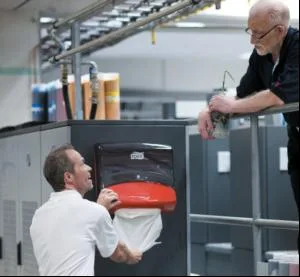
Tork Premium 530, for example, is suitable
for heavy industrial cleaning since it is tough
enough to be used with solvents but has
been designed to efficiently release the
solvent back on to the working surface. It is
available in the W4 wall-mounted Tork
Performance dispenser which protects wipers
from dirt and contamination before use. The
product is part of the Tork Premium
Multipurpose 500 series of wipers which
have low electrical charging for added safety.
The use of impregnated wipes can also
help to improve workplace safety since it
removes the need for using ‘neat’ liquid
chemicals. For example, Tork Wet Wipes
Surface Cleaning are impregnated with a
detergent that has been dermatologically
tested to be safe to use on the hands.Wipes
are enclosed in a sealed container which
removes the potential hazard of an open
bucket of cleaning fluid, while protecting the
wipes from drying out before use.
Different rules apply in food environments
where the risk to employee safety arises not
from harsh chemicals, but from bacteria
from raw foodstuffs.When researching the
market for our new Tork Performance
dispensing system we came across food
environments where centrefeed wiper
dispensers had long since cracked, leaving
the paper roll exposed to contamination.We
also found loose wiper rolls on food surfaces
where the trailing end could potentially
become contaminated with bacteria.
In these environments tightly-sealed
dispensers such as those in the Tork
Performance range will protect the wipers
from contamination. In food environments
colour-coded cloths can help to ensure that
cross-contamination is avoided. Tork
Premium Specialist Colour-Coded Cloths for
example allow staff to link each wiping task
or surface with a specific colour of cloth.
An appropriate wiping system can play its
part in the safety of any manufacturing or
food environment. Pre-moistened wipers,
colour-coded cloths, effective non-wovens
and durable dispensers as part of a cohesive
wiping system all have a role to play in
minimising safety risks – while contributing
to a more efficient working environment.
IPE Newsletter
IPE publishes a weekly eNewsletter, delivering a carefully chosen selection of the latest stories straight to your inbox.
Subscribe here