

Working safely at high level
Roof access is often needed for equipment inspection and
routine maintenance. It is vital that appropriate safety
systems are specified, installed and maintained. Here,
Safetyworks & Solutions details some of the systems a
Roof access is often needed for equipment inspection and
routine maintenance. It is vital that appropriate safety
systems are specified, installed and maintained. Here,
Safetyworks & Solutions details some of the systems available
Although recent years have started to
see a reduction in falls from height,
it still remains the largest cause of
workplace fatalities and one of the main
causes of injury. Therefore, it is vital that the
most suitable roof safety systems are
specified, installed and maintained. Training
of personnel to use the safety equipment
correctly is essential too, and an area that can
sometimes be overlooked.
Walkways
It may be necessary on certain roofs
(including fragile roofs) to provide a level
non-slip surface and, coupled with the
increasing requirement for extended
longevity of roofing materials, this has led to
an increased need for the use of walkways.
Several different types of roof walkways are
available and all options can be installed in
conjunction with handrail, fallguard or a
demarcation system.
When installed in conjunction with
handrails, roof walkways provide a collective
approach to safe roof access. They provide
safe access across roofs, and can be used on
many different roof types including: Standing
seam; membrane (Protan, Bitumen, Trocal),
metal profiles (composite, Secret Fix, built
up); traditional (slate, tile, copper, lead, cement).
By creating a designated walkway across
the roof, maintenance costs are lessened as
the amount of foot traffic is minimised. This
in turn helps to extend the lifespan of the
roof. It also allows for any roof maintenance
works to be completed easily and no
additional user training needed.
Walkways are particularly suitable for
installation on standing seam aluminium
roofs where regular access is required. A
walkway system will allow easy, safe access
for maintenance personnel and avoids the
need to use the seam as a step. The load is
spread on large regular bearers, reducing risk
of damage to aluminium roof trays and
cement roofs, and preventing personnel from
falling through brittle cement/asbestos roofs.
A peripheral fall protection system, such
as Safetyworks & Solutions’ Fallguard System
can be used in conjunction with, for
example, a Flexideck Walkway System. This
combination will ensure that if a user falls
sideways, they will not pass through a brittle
roof sheet. It is essential that the installed
walkways and fall protection systems are
lightweight, easily cleaned and rot-free. Nonpenetrative,
the roof’s integrity will not be
compromised during installation. Although
usually in light grey, bright colours can be
specified or used as edgings.
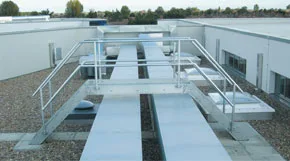
Roof gantries
Where it is necessary to access high-level
plant and equipment a raised steel gantry
system would be suitable. The gantry can be
supported by steelwork installed at ground
level, or can be suspended from existing
structures. Maintenance operatives will then
be able to achieve safe access onto roofs,
voids and roof plant, and across obstructions.
Roof lights
Roof lights are a major hazard on roof
structures, and personnel accessing the roof
must be aware of the drops around the outer
edges. Covers or guardrail systems may
protect roof lights or, alternatively, employees
working around roof lights may be protected
with personal fall arrest systems. The best
method of protection depends on the nature
of the work. For example, when employees
are exposed because of the work that they are
performing on the roof, then a guardrail
system or cover would be most suitable. If
the work is removal, replacement or reglazing
to the roof light itself then a personal fall
arrest system may be more appropriate.
Access ladders
Access ladders offer a secure and steady
access route onto, and across the roof for
maintenance work, and in the event of a fire
within the building, they could be one form
of escape route out onto the roof.
Steel ladders can be supplied with safety
cage or vertical fall arrest systems for
permanent access, and can include landing
platforms. They can take the form of vertical
ladders to access areas at height, up and over
ladders to access plant, and Cat ladders.
Ladders ideally should not exceed 6m, and
vertical fall arrest systems should never be
used in conjunction with cages.
Modem access ladders can be suitable for
a variety of locations, including offices, public
buildings, private housing and apartments
blocks, and can be fixed onto wood, brick
and metal structures. They fold out to
become a ladder, and as they can only be
released from above, are vandal and tamper
resistant. This type of ladder is suitable for
fire escape routes from windows. Access
steps, safety harnesses and rescue chairs can
be used in conjunction with access ladders
for disabled persons.
It is important to consider the following
before specifying a roof access system:
How often will the roof require access, and
for how long, and by how many people?
Identify hazards
Assess risks
Specify the most suitable access systems
Ensure personnel are fully trained to use
the equipment correctly
Carry out Annual Inspection and
Certification of Equipment to ensure it
meets industry standards.
IPE Newsletter
IPE publishes a weekly eNewsletter, delivering a carefully chosen selection of the latest stories straight to your inbox.
Subscribe here