

Workshops open eyes to change
To help engineers keep up-to-date with the latest developments, suppliers
often host seminars to discuss use of their products.Henkel, for example,
offers free, customised workshops that explain to maintenance engineers
ho
To help engineers keep up-to-date with the latest developments, suppliers
often host seminars to discuss use of their products.Henkel, for example,
offers free, customised workshops that explain to maintenance engineers
how adhesives can assist them in their everyday activities
Every well-run industrial plant needs a
maintenance routine. The problem with
the word ‘routine’ is the fact that it
frequently denotes doing ‘things’ the way they
have always been done. Often that is fine, but on
occasions there may well be a better solution and
it can sometimes take an engineer from outside
the organisation to recognise that fact and offer
an improved way forward.
Many suppliers host workshops and seminars to discuss
use of their products. Understandably, a question
commonly asked is whether it is beneficial to allow
engineers to take time away from the job to attend such
gatherings and, more importantly, will there really be a
payback in the long run?
Henkel believes that if the responses it gets from its
Maintenance Workshops are anything to go by, then the
answer is a resounding ‘yes’. The company’s Simon Groom
comments: “There certainly has been considerable interest
in our Workshop Training programme.”The purpose is to
reduce costs and improve efficiency – and that goal is
regularly achieved. Changing methods or products often
allows companies to salvage worn parts and reduce
downtime, all of which is good news.”
Groom emphasises that not only are the products
demonstrated, but there is plenty of opportunity for
hands-on experience. Prior to that,Henkel engineers
undertake a full analysis of the company’s current
practices and technologies.
“After a workshop session has been agreed, one of our
trainers – all of whom are engineers – will carry out a
plant survey. Every application that involves, or
potentially involves, a product in our portfolio is carefully
scrutinised. The engineer will visit the stores to ascertain
the range of technologies currently used. This information
enables us to tailor a workshop that fits the well-defined
needs of that business,” he explains.
Master modules
Although each workshop is organised to meet specific
needs, the overall elements can be separated into three
general groups.
The Standard Reliability Training module covers
procedures such as threadlocking, gasketing, pipe and
thread sealing and retaining. Topics discussed include the
advantages and disadvantages of threaded fasteners, how
substrates perform in different situations, why gaskets fail,
rigid versus flexible flanges, types of cylindrical fittings and
servicing factors.
The Maintenance Solution Training module focuses on
lubrication, bonding and flexible sealing,metal rebuilding,
surface treatment and rust prevention. Topics include the
salvage and rebuilding of worn parts, the advantages of
metal-filled epoxies, the benefits of anti-seize products and
the joining of dissimilar materials.
An Additional Training module discusses removal of
cured residues, the most suitable method of
cleaning/degreasing components, and the selection of
appropriate hand cleaners.
Success stories
Prior to its participation in a workshop, a recycling plant
was experiencing difficulties with leaking pipes and
misaligned pressure gauges. It emerged that the standard
practice was to use PTFE tape to lock the joints.Where
misalignment took place (when the pressure gauge was
facing in the wrong direction, for instance), the fittings
had to be backed off – causing the tape to loosen and
allowing leakage to occur.
At a workshop, the Henkel engineer demonstrated an
anaerobic pipe sealant that permits fittings to be tightened
to the optimum position with no risk of leakage. Any
surplus sealant outside of the joint can be readily wiped
away for a clean finish.
Elsewhere, a butterfly control valve in a waste water
treatment plant was corroded and unable to seal
effectively. The solution involved components being
abrasive blasted and a thin coat of a brushable ceramic
applied to the surface. Each rough and corroded edge of
the valve was then re-profiled with wear-resistant putty
before a final coat of another ceramic was applied.
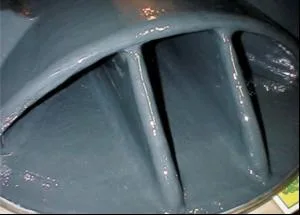
Another success involving coatings on a 50cm pump
used to transfer potable water to fill three gravity feed
reservoirs. After discussions with Henkel engineers, it was
decided to reclaim and rebuild the worn housing and
impeller of the pump using polymer composite materials.
Following recommissioning, the pump ran smoother and
quieter, water flow was increased and the pump drew 3
amps less current.
Groom concludes “Each session lasts around 2 hours
and we provide all the training materials. Putting into
practice the things that have been learned at the
workshops has resulted in a cutback of energy costs and
improved plant safety through the elimination of hazards.
Both scheduled and unscheduled stoppages will be
reduced – with the result that the quality of production
will be improved and output enhanced.”
IPE Newsletter
IPE publishes a weekly eNewsletter, delivering a carefully chosen selection of the latest stories straight to your inbox.
Subscribe here